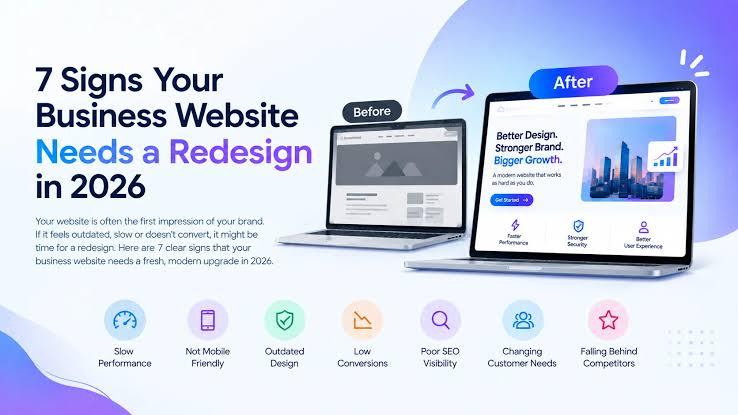
For years, businesses judged a website by a familiar set of questions.
Does it look professional?
Does it work on a phone?
Can customers find the phone number?
Does it show up in Google?
Those questions still matter. But they are no longer the whole picture.
Website design in 2026 is changing because the way people find businesses is changing.
Customers still use Google. They also use ChatGPT, AI Overviews, AI Mode, image search, Google Lens and other tools that may interact with a website before a potential customer ever clicks through to it.
That means a modern business website has a bigger job.
It needs to work for people, search engines and AI systems at the same time.
Good Design Still Matters
AI has made building basic websites faster.
That does not make good design less important. It arguably makes it more important.
Wix reported that the average time required to publish a website dropped from eight days in 2025 to four days in 2026 as AI-assisted creation increased. When almost anyone can produce a basic site quickly, a distinct design becomes one of the ways a legitimate business separates itself from thousands of interchangeable websites. wix.com
That distinction comes from more than colors and fonts.
A strong website should make it immediately clear:
- Who You Are
- What You Do
- Who You Help
- Why Someone Should Trust You
- What They Should Do Next
If visitors need to hunt for those answers, the design is creating friction instead of removing it.
SEO Can No Longer Be An Afterthought
One of the biggest mistakes in website projects is treating SEO as something that gets added after the site is finished.
A page can look great and still have poor search structure.
Good website architecture starts with decisions such as:
- Page Hierarchy
- Heading Structure
- Descriptive URLs
- Internal Links
- Page Titles
- Metadata
- Mobile Usability
- Performance
- Image Optimization
- Structured Content
Those decisions affect how visitors navigate the site, but they also help search engines understand it.
Google’s current guidance for its generative AI search features is straightforward: traditional SEO fundamentals still matter. Pages must still be indexable, technically accessible and useful enough to deserve visibility. There is no secret separate switch for appearing in AI Overviews or AI Mode. Google for Developers
That is why we approach website design and SEO as one system rather than two unrelated services.
AI Search Is Changing Discovery
Traditional search is not disappearing.
But discovery is becoming more fragmented.
A potential customer might:
- Ask ChatGPT for businesses that provide a service.
- Read a Google AI Overview.
- Search the company name directly.
- Visit the website to confirm that the business looks legitimate.
- Compare services, examples and expertise before making contact.
Wix’s 2026 website data found that traffic directly from large language models still represents less than 1% of site traffic, but that traffic grew fourfold between 2024 and 2025. Its broader data also shows AI systems visiting increasing numbers of websites as they retrieve information in response to users’ questions. wix.com
So the goal is not to abandon Google and chase a new acronym.
The goal is to build a website with information worth retrieving.
Your Website Needs Content AI Can Understand
AI systems do not care how many buzzwords are packed into a homepage.
Clear information wins.
A business website should contain direct answers to questions such as:
- What services does the company provide?
- Where does it operate?
- What industries does it serve?
- What makes its approach different?
- What experience does it have?
- What real work can it show?
- How does someone contact the business?
- What useful knowledge can the company contribute?
Service pages, case studies, technical articles and FAQs all help create that context.
Google’s own guidance emphasizes valuable, unique content rather than commodity content created simply to manipulate AI or search systems. Google for Developers
That should be good news for legitimate businesses.
You do not need to write for robots.
You need to explain your business clearly enough that both people and machines can understand it.
Visual Search Is Becoming Part Of Website Design
The visual side of search is changing too.
Google recently introduced Search Console reporting for multimodal searches, including searches performed through Lens, Circle to Search and uploaded images. Google for Developers
That makes image quality and image context more important.
Website imagery should not be treated as decoration.
Good images can help communicate:
- Products
- Locations
- Completed Work
- Services
- Equipment
- Processes
- People
- Before-And-After Results
Images should also be implemented correctly with descriptive context, sensible file sizes and appropriate alternative text when the image conveys meaningful content.
As search becomes more visual, businesses with original photography and real project imagery have an advantage over businesses using the same generic stock photos as everyone else.
Mobile Design Is Still Non-Negotiable
AI may be changing search, but customers are still holding phones.
A website that looks impressive on a 27-inch monitor and falls apart on a phone is not finished.
Responsive design should account for:
- Navigation
- Heading Size
- Button Placement
- Forms
- Images
- Tables
- Spacing
- Touch Targets
- Page Speed
And responsive testing should happen throughout the project, not five minutes before launch.
The objective is not simply to make everything smaller.
The objective is to preserve the hierarchy and usability of the design at every meaningful screen size.
Case Studies Matter More Than Generic Claims
Businesses often fill websites with phrases such as:
Quality service. Professional results. Customer focused.
Those statements are easy to write and difficult to prove.
A strong case study can do more.
It can show:
- The Challenge
- The Strategy
- The Design
- The Development
- The Technical Work
- The Final Website
- The Results That Can Be Verified
That gives potential customers something concrete to evaluate.
It also creates valuable internal links between your portfolio, service pages and Blog content.
For a web design company, the website itself should be the first case study.
Your Blog Is Part Of The Website Architecture
A business Blog should not exist just because somebody said blogging helps SEO.
The Blog should support the rest of the website.
For example, an article about when to redesign an outdated website should naturally connect to a Website Redesign service page.
An article about SEO structure should connect to the SEO service page.
A technical article can support a related Case Study.
That creates a useful content path:
Article → Service → Proof → Contact
That structure helps visitors explore a subject naturally and gives search engines stronger relationships between the site’s pages.
A Modern Website Has To Do More
The definition of a good website is expanding.
It still needs to look professional.
But it also needs to:
- Load Quickly
- Work On Every Device
- Explain The Business Clearly
- Support Search Visibility
- Provide Useful Content
- Show Real Work
- Create Clear Conversion Paths
- Support AI And Modern Search Discovery
- Remain Easy To Maintain And Expand
That is why we do not approach website design as decorating a template.
The goal is to build a digital platform around the business.
Is Your Website Ready For The Way Customers Search Today?
If your current website was built several years ago, it may still function perfectly well while falling behind in structure, mobile experience, content strategy or search visibility.
That does not always mean starting over.
Sometimes the right answer is improving the architecture, modernizing the design and preserving the parts that already work.
Innovative Marketing Solutions builds custom websites around the business rather than forcing the business around a template.
If you are considering a new website or redesign, we can look at what you have, what needs to change and what the website needs to accomplish next.
Get A Free Estimate
(904) 439-6279
imswebworks.com